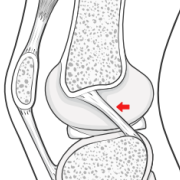
In this illustration, looking at the knee from the side, the joint has been cut in half to show the position of the posterior cruciate ligament.
The posterior cruciate is one of the two cruciate ligaments which are important in stabilising the knee. Page updated April 2024 by Dr Sheila Strover (Clinical Editor)
In this illustration, looking at the knee from the side, the joint has been cut in half to show the position of the posterior cruciate ligament.
It reaches from the back of the upper end of the tibia bone to the roof of the notch in the femur at the front.
The posterior cruciate ligament is comprised of two "....functional bundles: the larger anterolateral bundle...and the smaller posteromedial bundle...." and "to have a grade III PCL injury, both bundles need to be torn...."
The anterior cruciate ligament (not shown) has an opposite function.
"....The posterior cruciate ligament (PCL) is the largest and strongest ligament in the human knee, and the primary posterior stabilizer...."
"....Common causes include dashboard injuries where the knee is forced into the dashboard during a motor vehicular collision. The PCL also can be injured secondary to falling forward onto a flexed knee. The most common sports where PCL injuries occur are football, skiing, soccer, and baseball. Less commonly, damage can occur due to a rotational hyperextension injury to the knee joint....."
Reconstruction is performed less often for posterior cruciate ligament tears than for anterior cruciate ones. The anatomy is more complex, although the associated instability tends to be less disabling.
Really, good restoration of function is the domain of the super-specialist. Surgeons need special expertise to reconstruct the posterior cruciate and also often need comparable expertise in the management of concurrent injuries of the posterolateral corner.