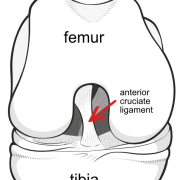
The anterior cruciate ligament is the one in the front, while at the back lies the posterior cruciate ligament.
The anterior cruciate ligament (ACL) is one of two strong ligaments supporting the knee joint by binding the femur and tibia together while crossing over one another inside the knee. Page updated July 2024 by Dr Sheila Strover (Clinical Editor)
The anterior cruciate ligament is the one in the front, while at the back lies the posterior cruciate ligament.
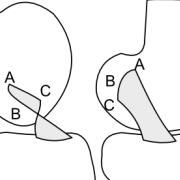
The ligament is comprised of two functional bundles - the anteromedial and the posterolateral bundle. The illustration shows how the load is distributed differently in flexion and extension. The wide footprint and the complexity of how loading differs in the two bundles have given surgeons a lot of headaches in their attempts over the years to reproduce the anatomy during a reconstruction procedure.
"....The anterior cruciate ligament (ACL) is considered the primary passive restraint to anterior translation of the tibia on the femur, and it provides rotational stability to the knee in both the frontal and transverse planes...."
However, there are a number of factors that predispose to anterior cruciate ligament injury - both anatomical and also related to the mechanism of injury.
"...multiple risk factors act in combination to influence the risk of ACL injury...Anatomic features, such as a decrease in femoral notch width, a decrease in the depth of concavity of the medial tibial plateau, and an increase in the posterior-inferior-directed slope of the tibial plateau, act in combination to increase the risk....Females are at increased risk...."
"....Noncontact mechanisms account for 60%–70% of ACL injuries....."
The nature of the injury is not always the same in different patients. Sometimes the ligament is sprained, rather than completely torn. Younger patients tend to have an avulsion from the bone, without any actual tear through the substance of the ligament itself.
"....The ligament may get avulsed from any one of its attachments. The severity may depend on the mechanism of injury ranging from a sprain to a complete tear of the ACL. There may even be an avulsion of a small piece of bone accompanying the ligament, which can be visualized on the X-rays. It can occur as an isolated ACL tear or involvement of a multi-ligamentous injury...."
Instability can be assessed by the surgeon with tests that pull the tibia forwards in relation to the femur - anterior drawer test, pivot shift test, Slocum test. The degree of abnormal movement can be quantified with instruments such as the KT 2000.
"....The physical examination has long been the mainstay of orthopaedic evaluation and diagnosis. The Lachman and anterior drawer tests are both clinically useful and highly specific, although the anterior drawer is less sensitive than Lachman. However, the lever test should have a more limited role, and findings should be interpreted with caution....."
Patients discuss whether or not a double-bunder ACL reconstruction offers benefits.