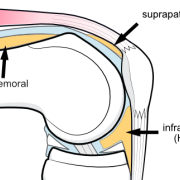
The three main fat pads in the knee.
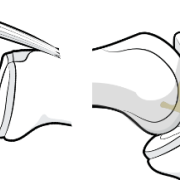
The Hoffa fat pad may be structurally connected to the infrapatellar plica and be stretched with movement.
The main fat pad - or Hoffa's fat pad - in the knee is an area of cushioning fatty tissue behind the patellar tendon - but there are also other fat pads in the knee above the patellar area. Page updated June 2024 by Dr Sheila Strover (Clinical Editor)
The three main fat pads in the knee.
The Hoffa fat pad may be structurally connected to the infrapatellar plica and be stretched with movement.
Because the fat pads are flexible, they change shape as the knee bends and straightens.
They are frequently traumatised in accidental injuries, but also during knee surgery, leading to distressing anterior knee pain.
"...the [infrapatellar plica] is abundantly vascularized and innervated....[with]....a high density of sensory innervation....[It] is covered with a synovial membrane [and] is connected to the intercondylar region and the synovial tube of the anterior cruciate ligament via the infrapatellar plica....[and]....attached to the anterior roots of both menisci...."
"....evidence suggests that high patellar height, TT-TG distance, and trochlear angle predispose the development of Hoffa’s fat pad syndrome."
"...the [infrapatellar fat pad - IFP] is (partially) resected in most total knee arthroplasties (TKA) allowing better visualization during surgical procedures. Currently, there is no clear guideline providing evidence in favor of or against IFP resection...."