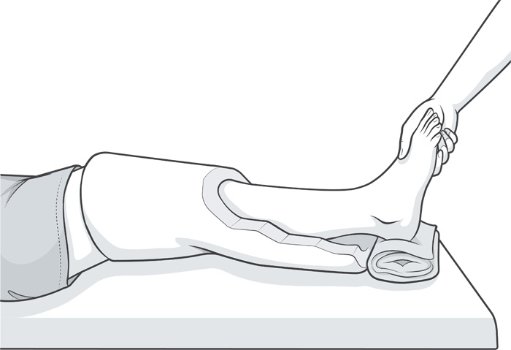
The drop-out cast is basically a plaster cylinder which can be slipped on and off the leg to allow bathing and physiotherapy exercise. The thigh is held firm in the cylinder. Below the knee, the front bit is cut away exposing the knee and leg.
A drop-out cast is an inexpensive splint for improving knee extension. Page updated March 2024 by Dr Sheila Strover (Clinical Editor)
The drop-out cast is basically a plaster cylinder which can be slipped on and off the leg to allow bathing and physiotherapy exercise. The thigh is held firm in the cylinder. Below the knee, the front bit is cut away exposing the knee and leg.
As the cast can be removed when needed, this allows different-sized pads to be serially placed under the ankle during physiotherapy sessions, gradually encouraging further knee extension. The advantage of this technique is that the patient is in control of the process and can apply or delete wedge material as tolerated and may remove the splint to use the bath.
NB. Casting is not recommended in knees that have greater than a -12° extension deficit with a hard block to terminal extension. (see paper by Dr Noyes).
"....Prevention of knee joint stiffness and potential arthrofibrosis should be a primary goal early post-operatively...."
Failure to achieve the last few degrees of extension during rehabilitation means that screw-home is not possible, and the whole limb will be under strain when standing.
"....It is important to recognize that even a loss of less than 5 degrees of knee extension ROM can lead to long-term patellofemoral pain issues, quadriceps strength deficits and a bent-knee gait abnormality....Failure to achieve full knee extension ROM can have a significant long-term impact on pain, gait and function, with arthrofibrosis as a potential complication...."