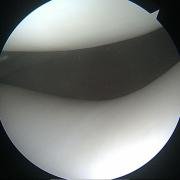
Normal joint cartilage of patella (seen above the femoral groove) (Grade 0).
Chondromalacia means 'softening of the gristle or joint cartilage' and usually refers to the kneecap (patella). The softening can be felt with a blunt probe during surgery. Page updated June 2024 by Dr Sheila Strover (Clinical Editor)
Normal joint cartilage of patella (seen above the femoral groove) (Grade 0).
The softening cannot be seen on X-ray, and cannot be determined by clinical examination, so the descriptive term should not be applied unless that surgeon has probed the knee under arthroscopy and determined that the cartilage is indeed softenend. Even then it is not right that the patient leaves the investigation under the impression that they have a disease called 'Chondromalacia'. They may have another problem, which, when managed effectively may relieve the stress on the cartilage.
Similarly, a patient should not leave the consultation believing that their diagnosis is 'Anterior Knee Pain' or 'Patellofemoral Pain Syndrome'. It may be possible to identify the reason why the front of the knee feels painful and the cartilage is soft - very often this is a mechanical problem which may be as simple as bad footwear, slight limb torsion, muscle imbalance, etcetera.
"...The primary....[cause]....includes trauma in the knee area, repeated microtraumas, sports wounds, osteochondritis dissecans caused by vascular disorders and inflammatory diseases."
Diagnosis "....requires the exclusion of diseases that can also lead to the symptoms of [anterior knee pain] syndrome, such as patellar malalignment, excessive lateral patella pressure, osteochondral injury, meniscal tear, Hoffa’s syndrome, and Synovial plica"
GRADE 0 - cartilage is normal and intact
GRADE 1 - cartilage has some softening and blistering (as in this photograph)
GRADE 2 - partial thickness (less than 50%) defect or minor tears in the surface of the cartilage
GRADE 3 - deeper defect - >50%
GRADE 4 - full thickness cartilage loss with exposure of the subchondral bone

"...Chondromalacia patellae may be reversible, or it could progress to the development of patellofemoral osteoarthritis."
If there is no improvement, then consideration will be given to correcting those structural problems most likely to be adding stress to the patellofemoral joint.
Articular cartilage, Anterior knee pain, Patellar malalignment, Excessive lateral pressure syndrome