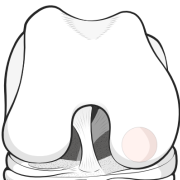
Illustration to show that a chondral defect is a discrete bit of damage, rather than diffuse arthritic wear and tear.
A chondral defect is an abnormal crater in the cartilage covering of a joint. Page updated March 2024 by Dr Sheila Strover (Clinical Editor)
Illustration to show that a chondral defect is a discrete bit of damage, rather than diffuse arthritic wear and tear.
Where the rest of the cartilage is healthy the isolated crater can be assumed to have been caused by an injury, where the joint surface and a bit of underlying bone has been knocked off. The person perhaps lands with force onto the bent knee, or there is a direct blow to the knee, knocking off a piece of articular cartilage. The chondral defect is the crater, while the bit that breaks off may carry on living freely in the joint as a 'loose body'.
Other non-traumatic conditions may create a similar crater, but the margins may be less discrete.
Such defects "...can occur as a result of mechanical factors (i.e. trauma or overuse leading to repetitive micro trauma) or biological factors (i.e. osteochondritis dissecans or osteonecrosis)"
The terms are, however, used a bit loosely, but the implication is that the walls of the defect are crater-like, and there may be a loose bit floating in the joint space.
A small awl may be used to poke through to the underlying bone to allow bleeding and migration of stem cells into the defect (microfracture) to encourage healing.
If the crater is large, and the cartilage around the edges healthy, then the surgeon may try to 'patch' fill the crater with healthy cartilage, in a 'cartilage repair' procedure such as in the procedure of mosaicplasty.
"...treatment of chondral knee injuries remains a challenge for the orthopaedic surgeon, mainly owing to the characteristics of the cartilage tissue, which promote low potential for regeneration...."