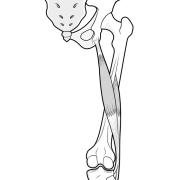
This illustration is from the back of the leg. The word 'ceps' means 'heads', so 'biceps' means that the muscle has two heads. There is a long head, and a short head. The long head forms part of the hamstrings muscle group.
The biceps femoris is the big muscle at the back of the thigh, contraction of which can flex and laterally rotate the knee. Page updated January 2024 by Dr Sheila Strover (Clinical Editor)
This illustration is from the back of the leg. The word 'ceps' means 'heads', so 'biceps' means that the muscle has two heads. There is a long head, and a short head. The long head forms part of the hamstrings muscle group.
Both heads of the biceps femoris are knee flexors, and the long head also helps to extend the hip.
Biceps femoris tendinitis is a painful problem caused by irritation of the tendon of the biceps muscle. It may occur as an 'overuse injury' following excessive exercise involving the hamstrings muscles, injury or following poor posture.
"Biceps femoris snapping over the fibular head is a rare condition...[due to] an anomalous insertion of the tendon into the tibia, trauma, and fibular-head abnormality."