Matrix-induced autologous chondrocyte implantation - or MACI - is a technique of cartilage repair involving growing cells on a matrix.
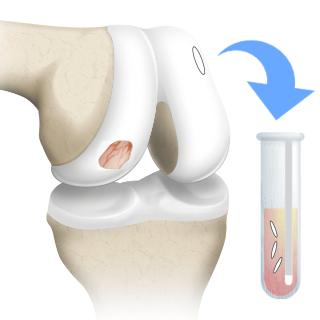
Matrix-induced autologous chondrocyte implantation - what does it mean?
The name of this procedure is a real mouthful! This is what it all means -
- matrix-induced - This is a two-stage procedure. The patient has one anaesthetic to remove a small piece of healthy joint cartilage from a relatively unimportant part of the knee. This is treated in a laboratory and the cartilage cells are extracted and allowed to multiply by being seeded onto a matrix.
- autologous - This means that the original cartilage piece used for the procedure is taken from the patient him/herself
- chondrocyte implantation - A chondrocyte is a cartilage cell, and it is the laboratory-multiplied cells that are placed back into the damaged area during a second anaesthetic.
MACI is one of several cartilage repair options
Most cartilage repair procedures rely on living cartilage cells, whether they are obtained as stem cells from the underlying bone via the procedure of microfracture, or transplanted within a cartilage plug such as in the OATS procedure, or multiplied in the laboratory and returned to the patient on a matrix which is glued into the original defect, such as in this MACI procedure.
Quick links
Forum discussions
- Right at the start! ACI/MACI. Dr Briggs.
A very active patient walks us through his decisions and procedures for mACI.
Peer-reviewed papers
-
Quote:
In this clinical study...."AMIC performed better than mACI for chondral defects of the knee at ~40 months follow-up. The rate of complications was noticeably lower in the AMIC group."
Citation: Migliorini F, Eschweiler J, Götze C, Driessen A, Tingart M, Maffulli N. Matrix-induced autologous chondrocyte implantation (mACI) versus autologous matrix-induced chondrogenesis (AMIC) for chondral defects of the knee: a systematic review. Br Med Bull. 2022 Mar 21;141(1):47-59. doi: 10.1093/bmb/ldac004. PMID: 35175354; PMCID: PMC9351375.