Complex regional pain syndrome or CRPS is an uncommon but very disabling pain disorder.
 Page updated January 2024 by Dr Sheila Strover (Clinical Editor)
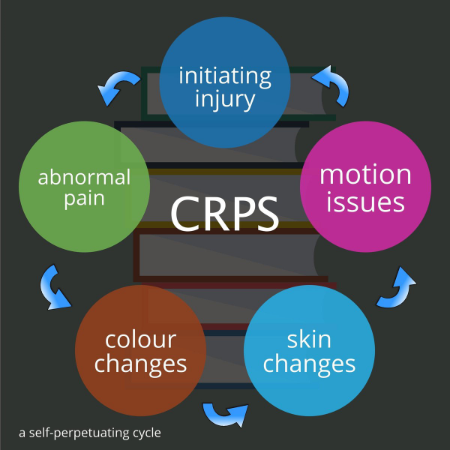
Causes of complex regional pain syndrome (CRPS)
CRPS is a group of symptoms which occurs very uncommonly after injury or surgery or prolonged joint immobilisation, especially in young people and in which there is an abnormal response to the injury where the vascular and nervous systems respond inappropriately to injury.
Features of CRPS
A 'syndrome' is a collection of symptoms that commonly occur together. In complex regional pain syndrome the collection of symptoms includes reduced range of motion, pain outside of normal expectations, and taut shininess and mottling of the affected limb, which is abnormally sensitive to touch. Very often the condition is triggered by an event such as an injury or surgery. Recovery begins as expected, but then suddenly everything seems to go wrong. The person starts to experience pain outside of the norms for that stage of recovery, and the limb may suddenly become mottled. A normal reaction is to keep the limb still, but in fact this tends to makes things worse, and the astute physiotherapist will gently keep the limb moving and use techniques of rehabilitation that will help to break this complex cycle.
How common is CRPS?
This condition is rare. The physiotherapist or surgeon is likely to be taken by surprise by the intensity and distress of the patient's symptoms, and may be slow to recognise the disorder. Trying to compel the patient to 'try harder' with the exercises and 'work through the pain' are likely to make things worse, and a frustrated practitioner may be faced with a distressed and disabled patient, until perhaps a pain consultant is brought in and recognises the situation before there is muscle wasting (atrophy) and true disability.
Peer-reviewed papers
-
Quote:
"Complex regional pain syndrome (CRPS) is a chronic neurologic condition resulting from a traumatic insult...It can be....divided into two subtypes, based on the absence (CRPS I, previously known as reflex sympathetic dystrophy) or presence (CRPS II, previously known as causalgia) of a major nerve injury."
Citation: Shim H, Rose J, Halle S, Shekane P. Complex regional pain syndrome: a narrative review for the practising clinician. Br J Anaesth. 2019 Aug;123(2):e424-e433. doi: 10.1016/j.bja.2019.03.030. Epub 2019 May 2. PMID: 31056241; PMCID: PMC6676230.
A clinician's experience -
 2017 - Why re-injury is common in CRPS patients - by Ms Michelle Boucher (Clinical Editor)
2017 - Early Recognition of CRPS after Knee Surgery - by Ms Michelle Boucher (Clinical Editor)